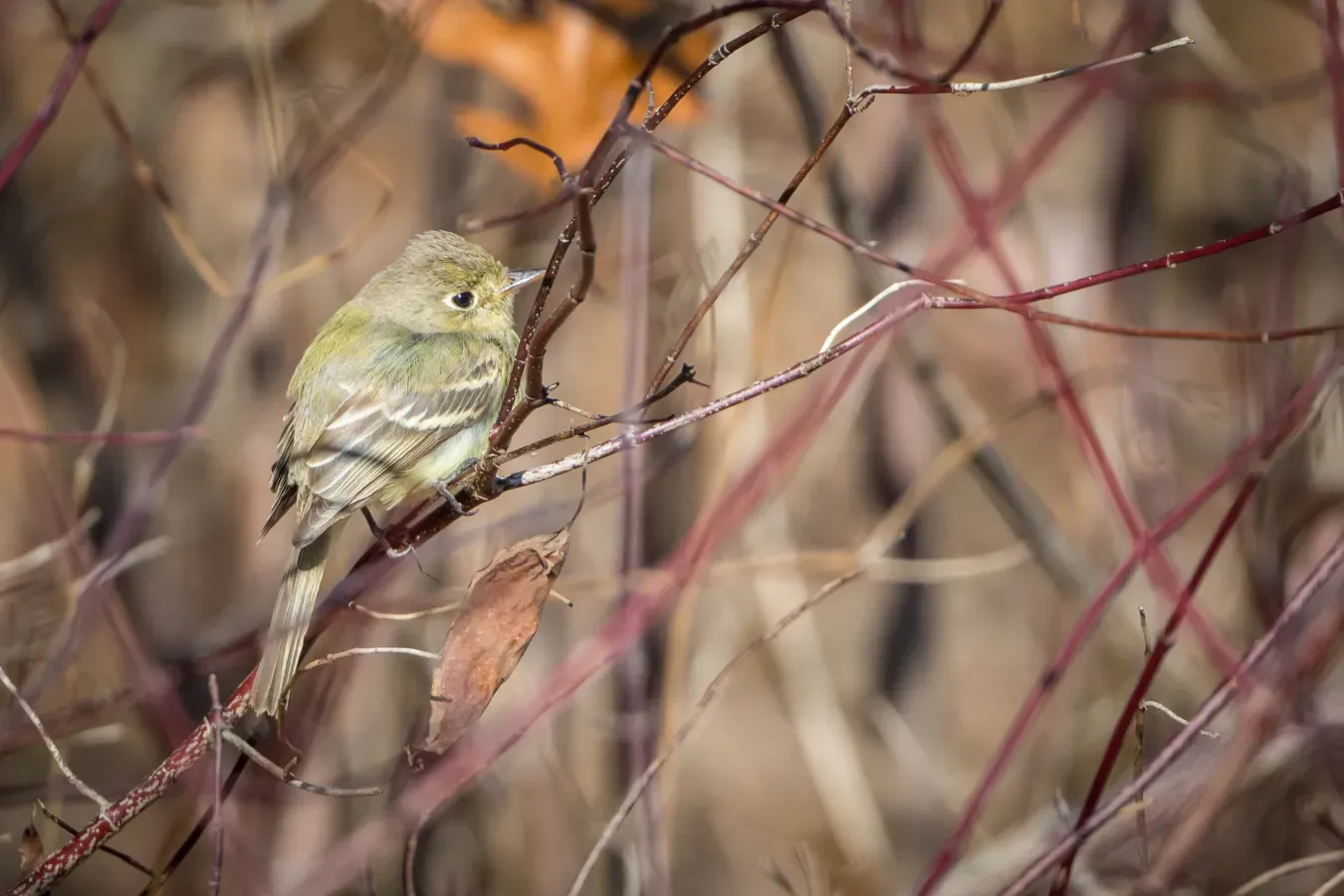
Western Flycatcher
Where to spot
Breeds in humid coniferous and mixed forests along the Pacific coast and mountains of western North America. Winters in Mexico and Central America.
How to spot
Listen for its distinctive, often two-part 'se-WIT!' or 'ts-SEE' call. Look for its yellowish wash, subtle eye-ring, and active foraging in dense understory or mid-canopy.
When to spot
Breeding: late spring to early summer in western North America. Migration: spring (April-May) and fall (August-September). Wintering: fall through spring in the Neotropics.
Where to spot
Breeds in humid coniferous and mixed forests along the Pacific coast and mountains of western North America. Winters in Mexico and Central America.
How to spot
Listen for its distinctive, often two-part 'se-WIT!' or 'ts-SEE' call. Look for its yellowish wash, subtle eye-ring, and active foraging in dense understory or mid-canopy.
When to spot
Breeding: late spring to early summer in western North America. Migration: spring (April-May) and fall (August-September). Wintering: fall through spring in the Neotropics.


Credits:
Wikimedia Commons

Credits:
Wikimedia Commons

Credits:
Wikimedia Commons

Credits:
Wikimedia Commons

Credits:
Wikimedia Commons

Credits:
Wikimedia Commons

Credits:
Wikimedia Commons
It was formerly considered conspecific with the Cordilleran Flycatcher, forming the 'Western Flycatcher' complex, with vocalizations and subtle range differences now used for separation.
Loading...
Spotted
No recently spotted birds
Monthly observations
1 observation
Loading...



Also interesting


Share this page
Or share directly on
