Greater Rhea
Greater Rhea
100
-
Points:
100
Not yet spotted on Fladder
Spotted
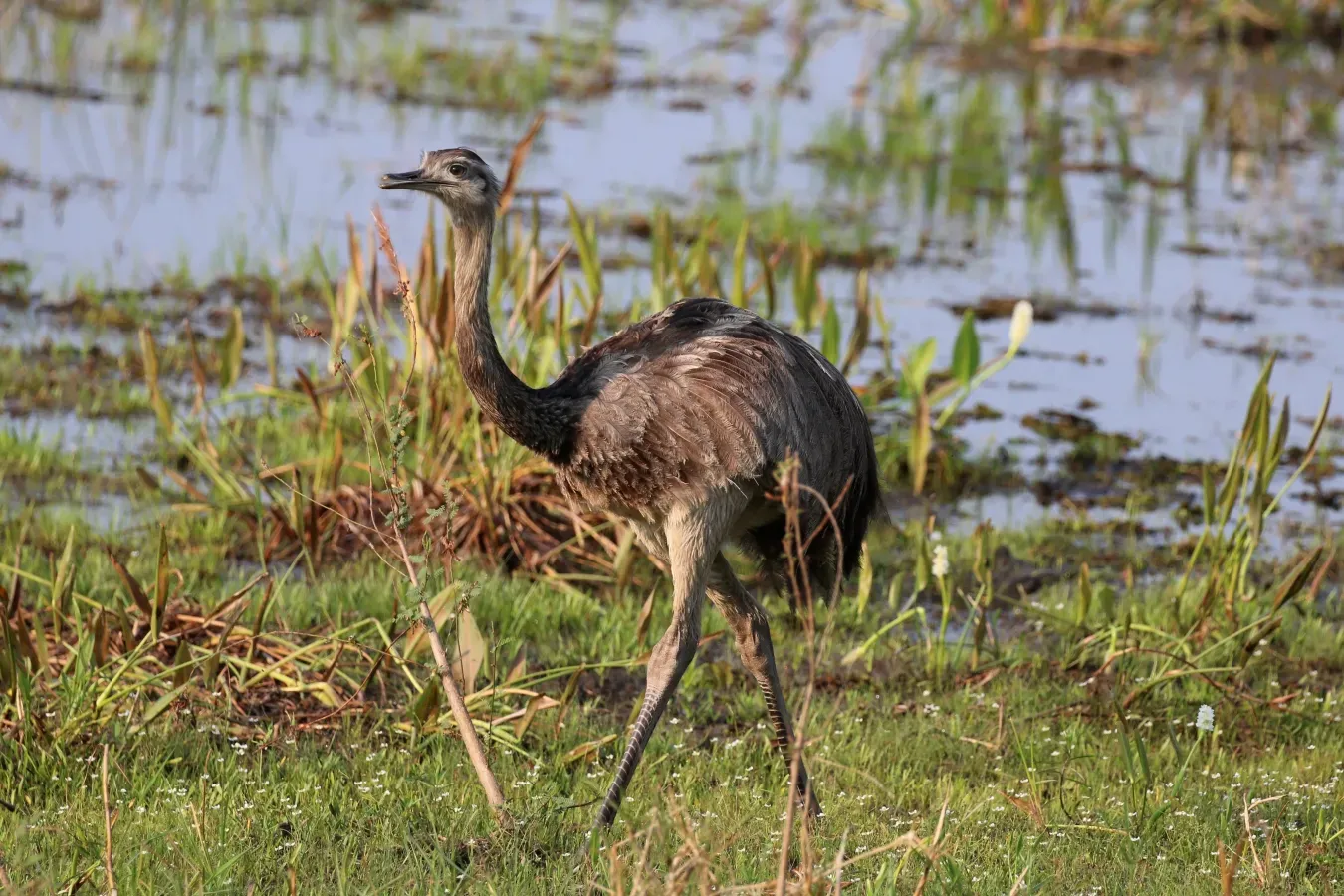
The Greater Rhea is the largest native bird in South America, resembling an ostrich but with three toes instead of two. These flightless birds are characterized by their long legs and neck, covered in soft, gray-brown plumage, and are well-adapted to the open grasslands and savannas of the continent.
Where to spot
Open grasslands, savannas, and shrublands across Argentina, Bolivia, Brazil, Paraguay, and Uruguay.
How to spot
Look for them in open areas, often in small groups or solitary. They are large and conspicuous but can blend into tall grasses. Use binoculars to scan the horizon and observe their characteristic upright posture and running gait. Approach slowly and avoid startling them.
When to spot
Active during the day, particularly in the cooler parts of the morning and late afternoon. Observable year-round as they are non-migratory.
Where to spot
Open grasslands, savannas, and shrublands across Argentina, Bolivia, Brazil, Paraguay, and Uruguay.
How to spot
Look for them in open areas, often in small groups or solitary. They are large and conspicuous but can blend into tall grasses. Use binoculars to scan the horizon and observe their characteristic upright posture and running gait. Approach slowly and avoid startling them.
When to spot
Active during the day, particularly in the cooler parts of the morning and late afternoon. Observable year-round as they are non-migratory.


Credits:
Wikimedia Commons

Credits:
Wikimedia Commons

Credits:
Wikimedia Commons

Credits:
Wikimedia Commons

Credits:
Wikimedia Commons

Credits:
Wikimedia Commons
Male Greater Rheas are solely responsible for incubating the eggs and raising the chicks. They build a communal nest, incubate eggs from multiple females (up to 50 from 12 females), and defend the young for several months after hatching.
Loading...
Spotted
No recently spotted birds
Monthly observations
No observations
Loading...
Nothing spotted yet
Also interesting




Share this page
Or share directly on
